What Is Pendulum Slip Resistance Testing (PTV)?
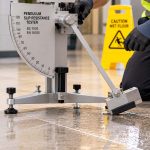
Pendulum slip resistance testing is a method used to assess the slip resistance of many pedestrian floor surfaces. It uses a swinging arm with a rubber slider that contacts the floor, producing a Pendulum Test Value (PTV). The result can help property owners and facilities teams evaluate a surface, provided the test is carried out and interpreted appropriately.
How does the pendulum test work?
A trained operator positions and levels the instrument, selects a suitable slider and test configuration, and performs controlled swings over the surface. The frictional interaction between the slider and floor affects the reading. Multiple readings and checks may be needed to produce a representative result.
What does PTV mean?
PTV stands for Pendulum Test Value. It is a measurement reported by the pendulum apparatus under specified test conditions. It should not be treated as a universal guarantee that a floor is safe in every situation: footwear, contaminants, slope, drainage, cleaning and user behaviour also affect slip risk.
Why test before and after treatment?
A pre-treatment test can document the starting condition. A post-treatment test, performed using comparable conditions and a suitable method, can help assess whether the measured slip resistance changed. The report should identify the test locations, conditions, equipment or method, slider where relevant, and results.
Which surfaces can be tested?
Slip-resistance testing uses a method selected for the surface and the conditions being assessed. Pendulum slip-resistance testing is a commonly used method for many pedestrian surfaces. Other methods may be appropriate depending on the material, geometry, environment and applicable standard. A new digital testing method has also recently been introduced and may offer improved accuracy in certain conditions; however, its results should be interpreted according to its validated method and should not automatically be treated as equivalent to Pendulum Test Value (PTV) results. The chosen method and its limitations should be clearly documented.
How should you read a slip test report?
- Confirm the site, date and exact test locations.
- Check whether the surface was tested wet, dry or under another specified condition.
- Review the method and equipment details.
- Compare like-for-like results and note any limitations.
- Ask the tester to explain what the findings mean for the actual use of the floor.
Slip resistance testing in the UAE
Hotels, malls, kitchens, public buildings and residential facilities may use slip testing as part of their maintenance and risk-management process. The appropriate test standard and acceptance criteria depend on the project requirements and applicable guidance. Do not assume a single PTV threshold applies to every surface or setting.
Ask GripBooster about floor testing
GripBooster can discuss slip-resistance assessment and anti-slip treatment options for suitable surfaces. Share the floor type, location and operating conditions so the appropriate assessment can be considered. Any performance statement should be supported by relevant test evidence for the specific surface and conditions.